


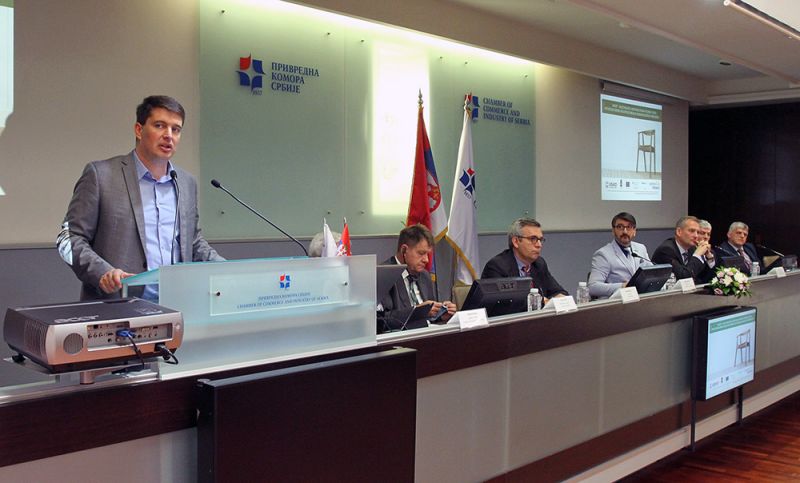
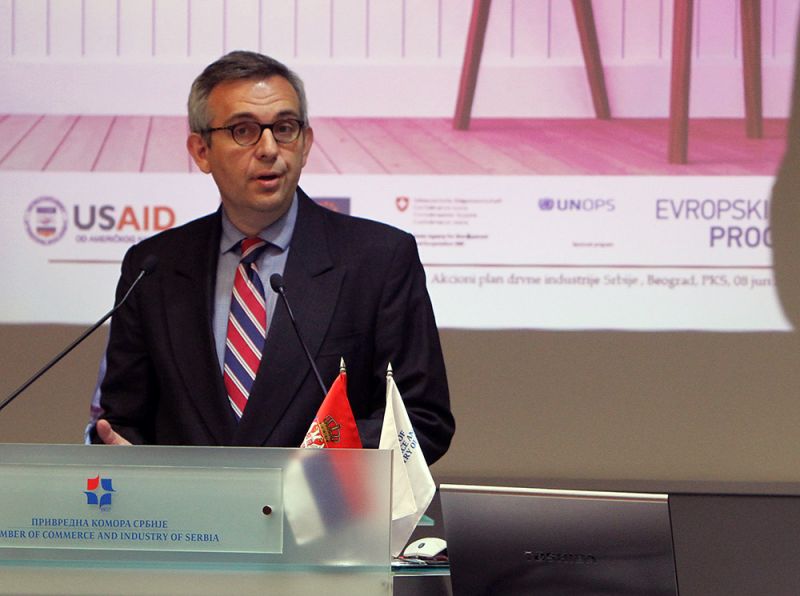
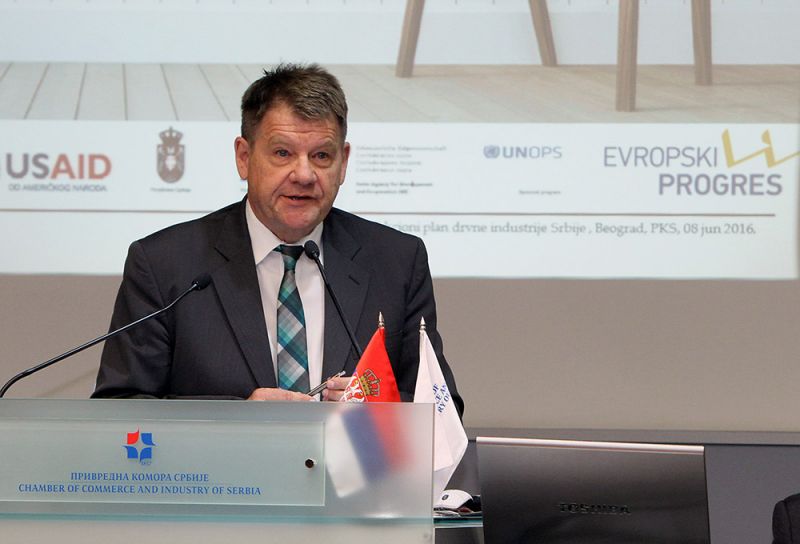
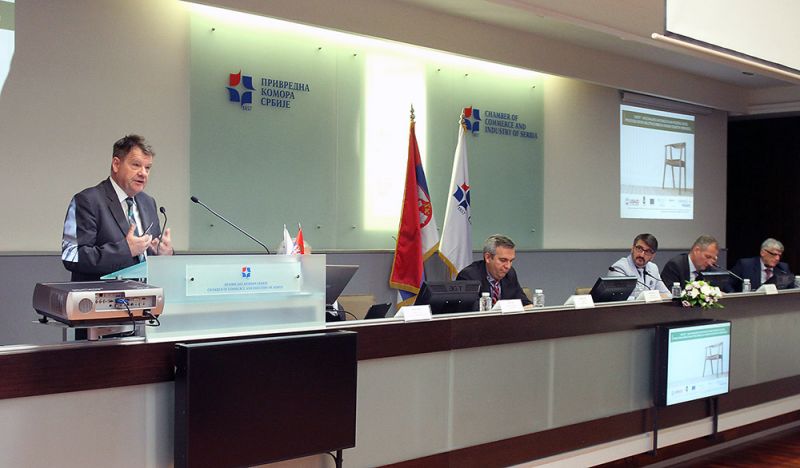
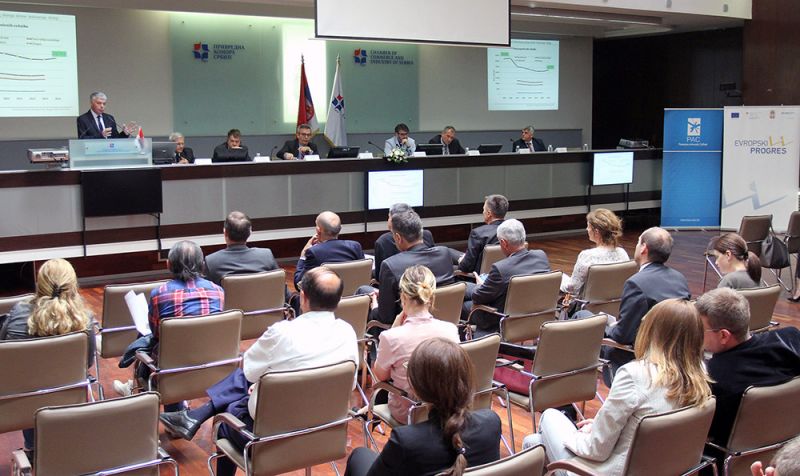

Today, the representatives of 46 local self-governments from South East and South West Serbia* submitted an Action Plan to position Serbia as solid wood furniture exporter to the Serbian Development Agency (RAS), which will take the lead to further present it before the new Serbian Government. The support in developing the Action Plan that was presented in the Serbian Chamber of Commerce was provided by the European Union and Swiss Government through the European PROGRES development programme, and the USAID Sustainable Local Development Project.
The Action Plan provides a range of measures to increase competitiveness of domestic producers and to enhance solid wood furniture production, having in mind the increased demand on the global and especially European markets, with the aim to create new jobs and boost export.
“The Ministry of Economy is prepared to support all activities that contribute to the economic development, as well as GDP and export growth, and the Action Plan presented today can on one hand help consolidate the Public Enterprise Srbija Šume, and on the other support small and medium businesses in the wood processing sector,” said Dragan Stevanović, State Secretary in the Serbian Government’s Ministry of Economy.
Ješa Erčić, Industry and Agriculture Sector Director in the Serbian Chamber of Commerce (SCC), confirmed SCC support to reviving solid wood furniture production, putting a particular emphasis on the importance of education in the wood production sector. “Starting with the next school year a new profile, Furniture Production Operator, will be introduced, and classes will be organised as cooperative training with elements of dual education, with two technical schools in Užice and Subotica implementing this programme,” Erčić said.
“European Union and Swiss Government, through European PROGRES, provide support to increase the competitiveness of local economies, and the cooperation of local self-governments and the private sector, with the support of government institutions, is a prerequisite for progress,” Graeme Tyndall, Manager of the European PROGRES development programme said, and added that the initiative demonstrated that the local self-governments had recognised their wood potentials as an advantage and foundation for economic growth. “This will create the opportunity for opening new jobs, which is particularly important if we know that one-fifth of the population from less developed municipalities, which are rich in wood potential, are employed in the wood processing sector.
“Less developed municipalities in Serbia hold 46% of overall forest resources in the country. By maximizing the degree of utilisation of these resources through the making of final products of the highest value, which can be placed on the world market at higher prices, we open opportunities for employment and growth of the private sector, instead of giving away the most valuable natural resource in Serbia as raw material,” Milan Pavlović, acting Director of USAID/Serbia, said.
Presenting the measures proposed in the Action Plan, Professor Branko Glavonjić, PhD, lecturer at the Faculty of Forestry of the University of Belgrade, said that the Action Plan provided guidelines to improve internal capacities of the wood producers with high added value, as well as a series of measures to improve the entire business environment, such as strengthening production capacities by introducing technological improvements, improving the education system and vocational training in accordance with the needs of the economy and promoting Serbia as solid wood furniture exporter.
Handing over the Action Plan in the name of 46 local self-governments to the RAS Director, Miloš Petrović, the Mayor of Tutin, Šemsudin Kučević, pointed out that the representatives of local authorities, numerous representatives of the wood processing sector and relevant government institutions, local and international experts all participated in the preparation of the Action Plan.
“The aim of support to wood industry is to encourage its export competitiveness, and it is expected that successful implementation of the proposed measures could enable the creation of thousands of new jobs and increase exports to over 500 million USD annually,” Miloš Petrović, Acting Director of the Serbian Development Agency said.
The initiative for the revival of wood industry was started by the USAID Sustainable Local Development Project and European PROGRES development programme, funded by the European Union and Swiss Government, in partnership with the Serbian Development Agency and Serbian Chamber of Commerce.
*The following local self-government have supported the Action Plan development: Arilje, Bajina Bašta, Bela Palanka, Boljevac, Bor, Brus, Čačak, Čajetina, Ćićevac, Crna Trava, Despotovac, Dimitrovgrad, Gadžin Han, Ivanjica, Knjaževac, Kosjerić, Kraljevo, Krupanj, Kruševac, Kučevo, Kuršumlija, Leskovac, Ljubovija, Loznica, Majdanpek, Mali Zvornik, Niš, Nova Varoš, Novi Pazar, Pirot, Priboj, Prijepolje, Raška, Ražanj, Sjenica, Surdulica, Svrljig, Trgovište, Trstenik, Tutin, Užice, Vladičin Han, Vranje, Vrnjačka Banja, Žagubica, Zaječar.
