


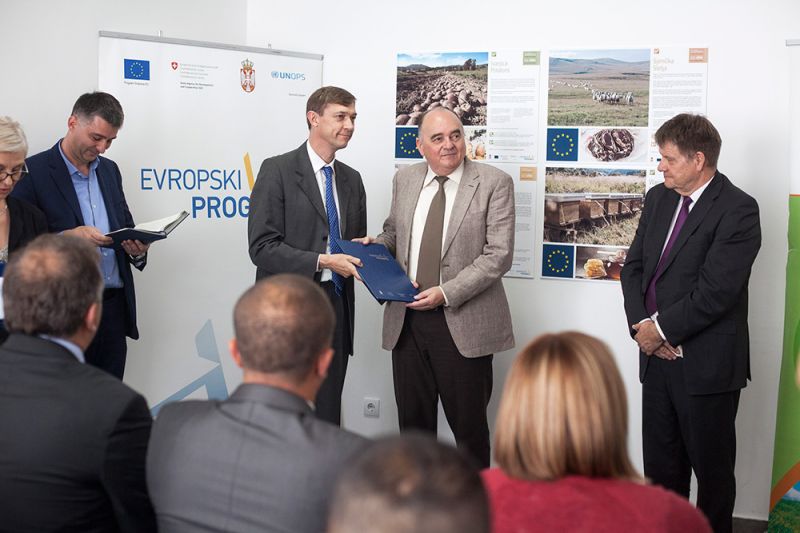
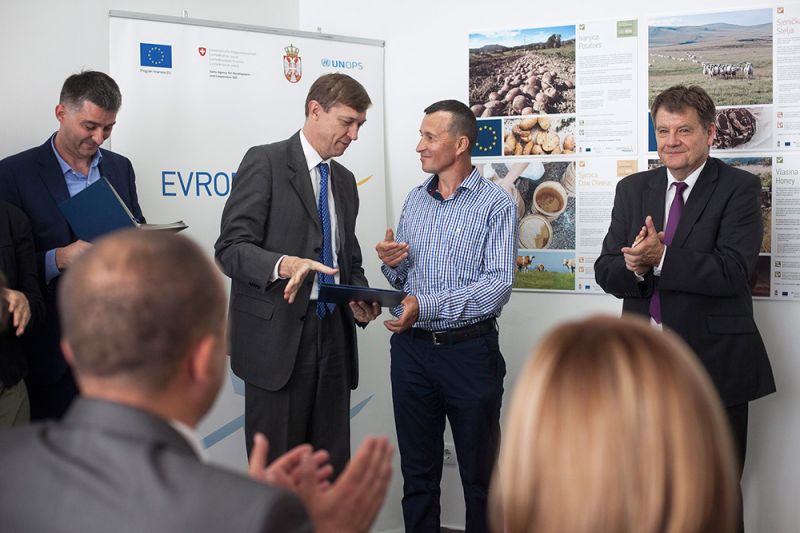
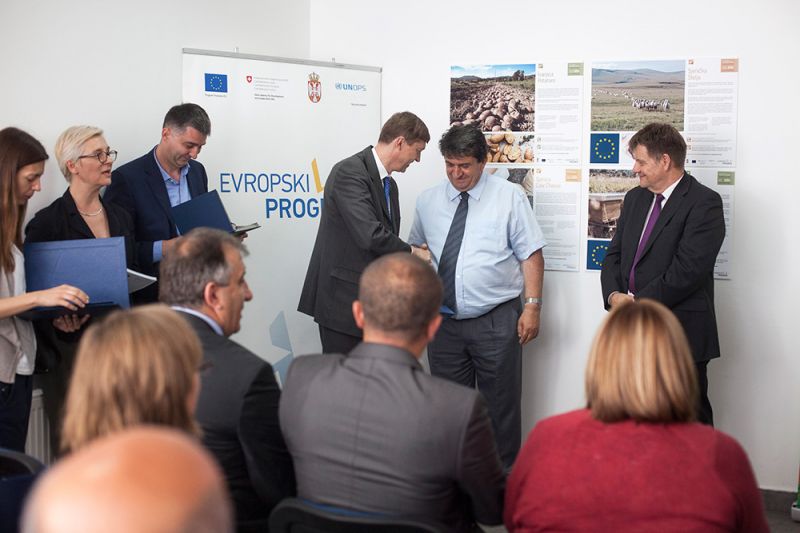
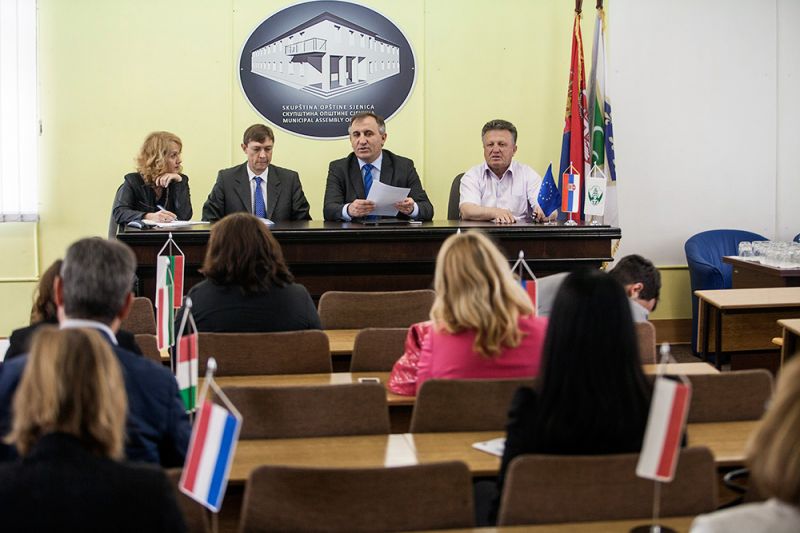
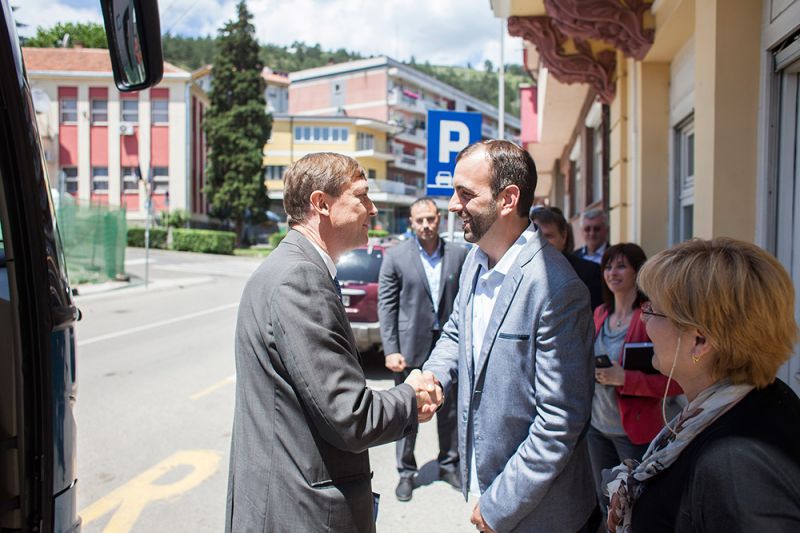
During the first day of visit by 17 deputy ambassadors of EU member states to South West Serbia, Oscar Benedict, Deputy Head of the EU Delegation to Serbia, handed the agreements on support for introduction of Protected Geographical Indication for four products – Ivanjica potato, Sjenica cow's milk cheese, Sjenica stelja (dried meat) and Vlasina honey that will be financed by the European Union and the Government of Switzerland through the development programme European PROGRES in the amount of EUR 40,000. The Programme will provide technical assistance in drafting the necessary studies and surveys during the protection procedure for these traditional products from the South West and South East of Serbia.
“Protected Geographical Indication enables producers to sell their products at a higher price and be more competitive since it represents the guarantee of their quality and additionally promotes a certain area”, said Mr Oscar Benedict during the ceremonial award of agreements that was held in the Regional Centre for Agriculture Development in Sjenica.
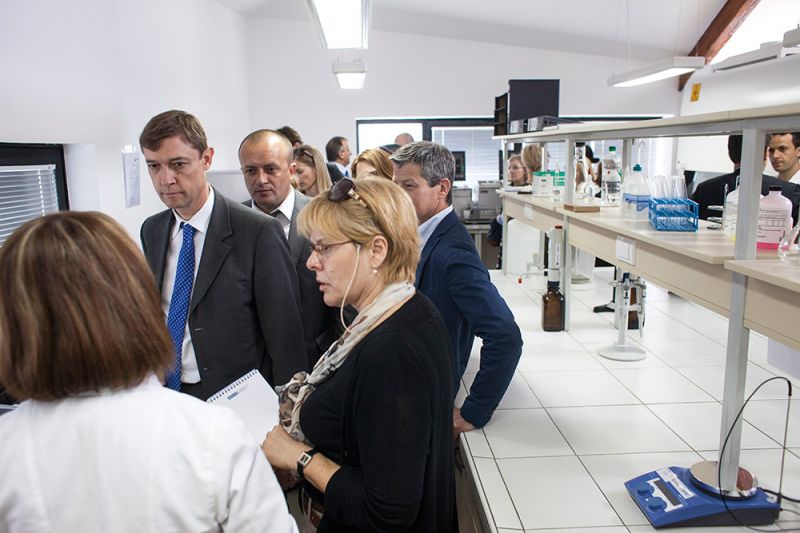
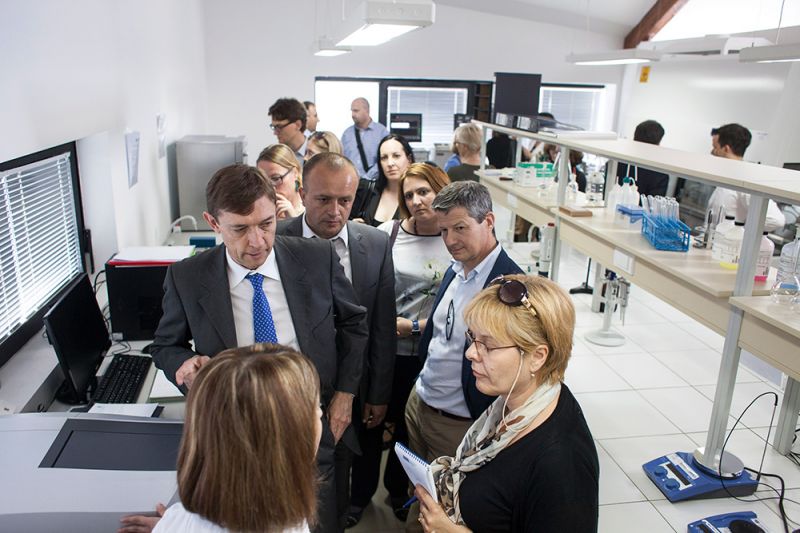
Construction and equipping of this centre were funded by the European Union and the Government of Switzerland through EU PROGRES - predecessor programme to the European PROGRES - with over EUR 255,000, while the Czech Development Agency invested EUR 200,000. The Centre equipped with a modern laboratory provides support in application of new technologies, product control and increased production volume to farmers from Novi Pazar, Tutin and Sjenica which should result in their increased revenues as well as improved agricultural production that is of great importance for the development of the entire region of South West Serbia.
The delegation of EU diplomats also visited Pester Agro Cluster gathering dairy producers from Novi Pazar and Sjenica that is implementing another in a series of projects by European PROGRES aimed at strengthening competitiveness of local economies. The European Union and the Swiss Government allocated EUR 40,000 in order to help the cluster members improve their capacities for production and sales of kajmak (clotted cream) to local and regional markets by introducing the traditional, centuries-old recipes through standardisation into modern industrial production.
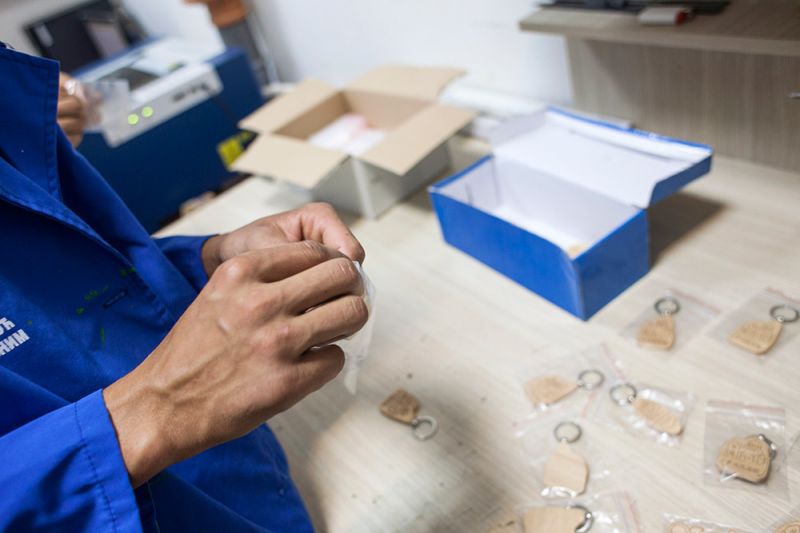
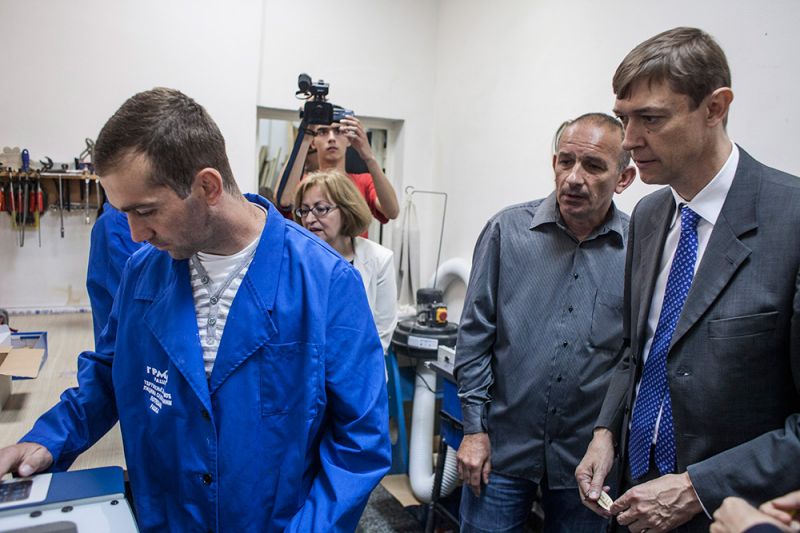
While visiting Raška, the delegation went to the Association for Assisting Persons with Special Needs, for which machines and tools for carpentry workshop were procured, enabling the initiation of continuous souvenir production and engagement of over 50 beneficiaries who learnt about carpentry and earned some income.
“We are glad to support projects like this one, that utilise workshops in helping persons with disabilities to lead normal lives,” said Deputy Head of EU Delegation, Oscar Benedict and added that there will be another important project in Raška – construction of waste water treatment facilities that will be treating water, thus contributing to the development of tourism and overall local economic development.
Social inclusion is one of the main principles promoted by the European Union and this project represents inclusion according to European standards, since vulnerable groups are involved in the labour market through the cooperation between local authorities and civil society organisations.
The delegation also met with the mayor of Raška, Ignjat Rakitić and the mayor of Sjenica, Hazbo Mujović. During the last ten years these municipalities were successfully involved in implementing development projects funded by the European Union - PRO, EU PROGRES and European PROGRES. The EU and the Government of Switzerland supported the implementation of over 50 projects worth over EUR 1.3 million in Raška and over 30 projects exceeding EUR 900,000 in Sjenica.
The delegation of seventeen representatives of the European Union ended their first day of the visit by meeting with the representatives of civil society organisations and the media. During the second day of the visit on 1 June, the delegation will visit Novi Pazar.
