


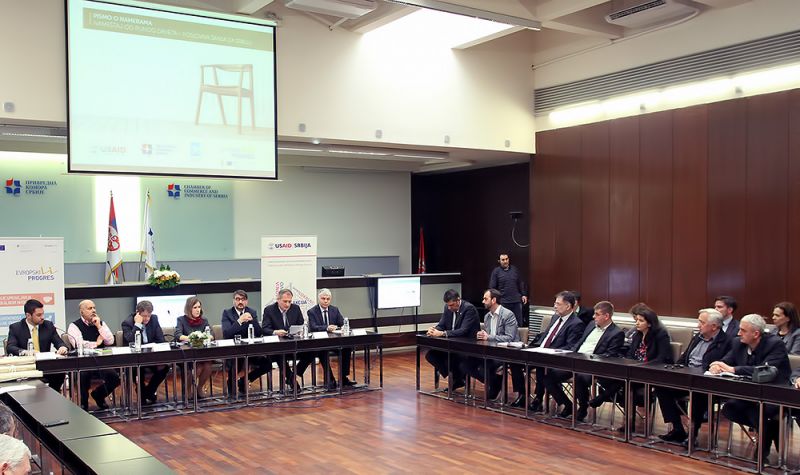


Representatives of 46 local self-governments* from South East and South West Serbia will take an active part in reviving the solid wood furniture production with the support of the European PROGRES, the programme financed by the European Union and the Swiss Government and USAID Sustainable Local Development Project. This will be done through support to the local economy, as was announced at the forum “Positioning Serbia as an Exporter of Solid Wood Furniture” that was held at the Chamber of Commerce and Industry of Serbia. Both the Chamber of Commerce and Industry of Serbia and the Development Agency of Serbia underlined their readiness to help restoration of the wood processing industry.
Mr Miloš Petrović, PhD, acting director of the Development Agency of Serbia welcomed the joint engagement of local authorities and industry in order to revive the furniture production in Serbia. “Our support to the solid wood furniture production sector will be directed at improvement of export capacity and potential so that Serbia and its companies could be recognized as reliable partners and desired destinations for procurement of this type of products”, said Mr Petrovic.
Mr Ješa Erčić, director of the industry and agriculture division of the Chamber of Commerce and Industry of Serbia emphasized that wood processing industry in Serbia with over 2,200 companies and around 23,000 employees accounted for 1.4 % of Serbia’s GDP. “Apart from agriculture, wood industry is the second most important sector in the country with trade surplus in the amount of 180 million dollars and with the growth tendency over the last few years”, said Mr Erčić underlining the potential and the need to provide support to further development of this sector.
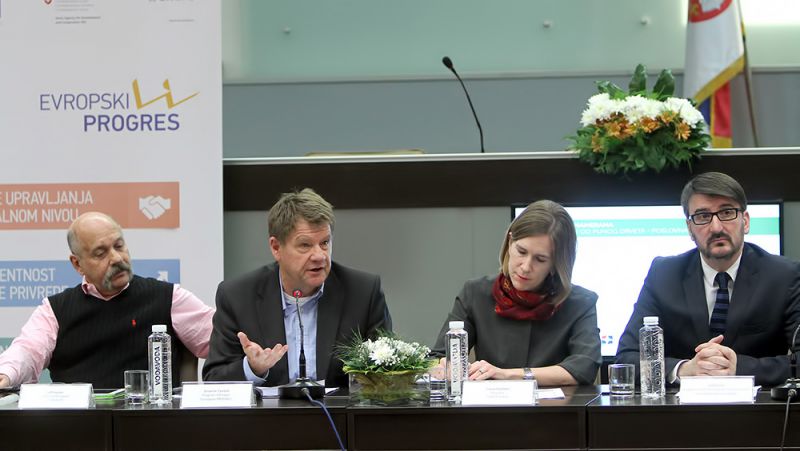
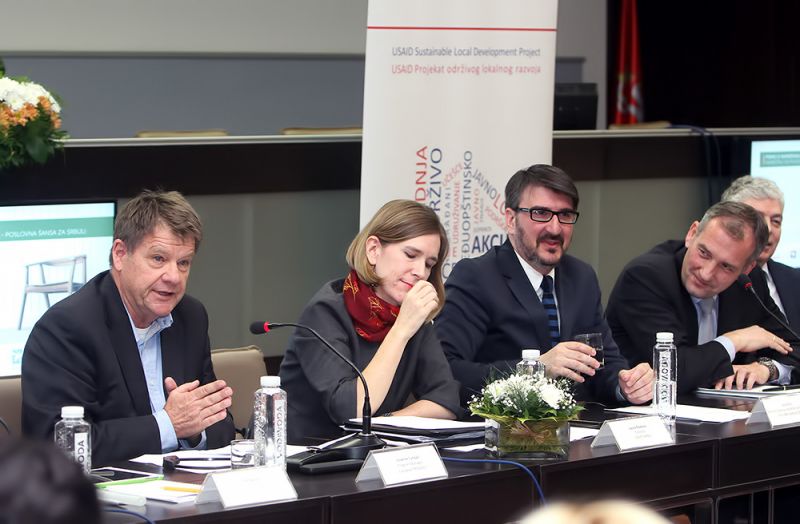
“European PROGRES, with the support of the European Union and the Swiss Government, is assisting the local self-governments to improve their competitiveness and this initiative is a good example how the municipalities are making an effort to use their wood potential as a comparative advantage” said Mr Graeme Tyndall, Manager of the European PROGRES programme. Tyndall added that cooperation of public and private sector was strengthening the local economy and creating opportunities to generate new jobs which is particularly important having in mind the data according to which only one fifth of the people from underdeveloped municipalities are working in the wood processing sector.
Talking about the initiative to revive the solid wood furniture production in Serbia, the director of Office of Democratic and Economic Growth at USAID, Ms Lora Pavlović, emphasized that all relevant stakeholders from public and private sector on the local and national level were involved in the implementation of this activity in order to achieve increased export and generate new jobs. This is particularly important for the underdeveloped municipalities of Serbia in which 46% of the total forest resources of the country are located.
Professor at the Faculty of Forestry from the University of Belgrade, Branko Glavonjić, PhD, said that Serbia has 1.4 million cubic ha of technical wood and that in order to increase the competitiveness we need to use the existing wood resources more efficiently and switch to the higher degree of wood processing in order to have products with high added value dominating the export structure because they can achieve the highest price on the international market.
Mr Jeff Baron, an international expert for furniture industry, talked about the potential for exporting to global market and pointed out that global buyers are now looking for new destinations to obtain the products outside Asia, where they can cut costs, provide faster delivery and easier transport which, with the accumulated knowledge and experience in combination with the existing solid production capacities, presents an opportunity for positioning Serbia as furniture exporter.
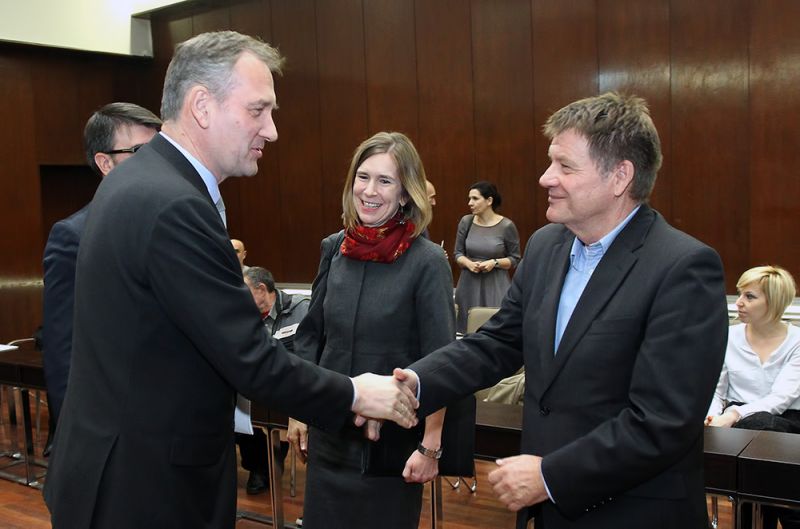
Upon completion of the working session of the forum, Graeme Tyndall and Lora Pavlović handed the Letter of Intent signed by the Development Agency of Serbia and Chamber of Commerce and Industry of Serbia to the representatives of local self-governments which is the first step in producing the Action Plan for positioning of Serbia as solid wood furniture exporter. The representatives of local self-governments, business sector and competent state institutions will participate in the implementation of the Action Plan with the support of USAID Sustainable Local Development Project and the European PROGRES programme.
The Action Plan will contain a series of support measures for the sector that will, among other things, involve the introduction of stimulative financial and non-financial support measures to the solid wood furniture manufacturers, adjusting the curricula in vocational secondary schools as well as strengthening cooperation between the state bodies, local self-governance units, organizations managing the forests, manufacturers of solid wood furniture as well as other participants in creation of a value chain.
The forum organized by the European PROGRES, programme financed by the European Union and the Swiss Government, and USAID Sustainable Local Development Project and in partnership with the Chamber of Commerce and Industry of Serbia and the Development Agency of Serbia gathered the representatives of towns and municipalities, representatives of furniture manufacturers, competent state institutions and public enterprises.
*The local self-governments that signed the letter of intent are as follows: Arilje, Bajina Bašta, Bela Palanka, Boljevac, Bor, Brus, Čačak, Čajetina, Ćićevac, Crna Trava, Despotovac, Dimitrovgrad, Gadžin Han, Ivanjica, Knjaževac, Kosjerić, Kraljevo, Krupanj, Kruševac, Kučevo, Kuršumlija, Leskovac, Ljubovija, Loznica, Majdanpek, Mali Zvornik, Niš, Nova Varoš, Novi Pazar, Pirot, Priboj, Prijepolje, Raška, Ražanj, Sjenica, Surdulica, Svrljig, Trgovište, Trstenik, Tutin, Užice, Vladičin Han, Vranje, Vrnjačka Banja, Žagubica and Zaječar.
