


As with many issues hindering the national development, there are no technical obstacles to practicing gender equality in Serbia in full. Under the Law on Gender Equality, men and women in Serbia enjoy equal rights, gender equality mechanisms (GEMs) exist to ensure local implementation of the Law and there are lax quotas to strengthen female participation in the administrative structures.
However, as the statistics show, the level of women participation in the legislature and enforcement is below acceptable standards; while the difference in pay for the same job for a women and man, is equivalent of a woman working 40 days a year without a pay.
Female representation in the national politics is low, with a 9.5% share of women in the Government of Republic of Serbia and 28.6% women members of the municipal assemblies. However, this average might be misrepresenting as in April 2015, out of 34 mayors of the Southern Serbian municipalities working with European PROGRES, only two are female.
Understanding that the development goals are out of reach as long as one half of the national workforce is inherently disadvantaged, European PROGRES Programme, supported by the UN Women, ensures that all of its activities include gender responsive planning.
The Programme’s gender activities are twofold. The primary focus is to help effective implementation of the National Strategy for Improvement of the Position of Women and Gender Equality. European PROGRES thus provides capacity development to effectively execute their gender relevant mandates to both the Government of Republic of Serbia and 34 local self-governments in the South East and South West Serbia. The second activity is aimed at empowering and strengthening women workforce in the Programme municipalities, through support of women entrepreneurship.
In 2009, the Law on Gender Equality was adopted requiring the local self-government (LSG) units to “form the bodies and/or appoint an employee in charge of gender equality.” Decisive to support the local legal solutions European PROGRES supports all 34 partner municipalities to establish Action Plans for gender equality and dedicated GEM budgets.
“Our goal is to create active and strong GEMs capable of advocating gender equality issues and achieving tangible results in their municipalities. To this end, during 2015, European PROGRES will also award grants to at least 30 GEMs in order to facilitate implementation of locally relevant activities which would ultimately result in the advancement of the position of women,” says Ana Nedeljković, the Programme Associate for Good Governance and Gender Equality.
The Programme also envisages integrating gender issues in the relevant local planning documents and subsequently - long-term budget cycles. To facilitate this, European PROGRES will select and train five fervent local self-governments to develop and execute gender responsive budgets.
It is necessary, especially at the local levels, to raise the awareness of citizens that the application of the equal opportunities principles is a legal right of every citizen and the obligations of local governments.
“Gender responsive budgeting is not simply about allocating funds. It is a process of recognising local problems that impede gender equality, identifying activities and organisations that can remedy these issues and utilising the limited funds to effectively address the local priorities,” says Ana Nedeljković.
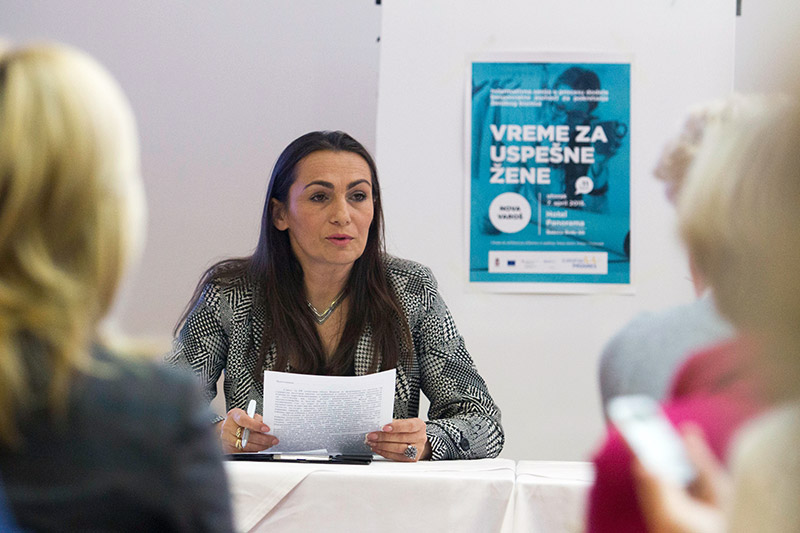
In the meantime the European PROGRES will support 40 women to start their own business, through the approval of grants totalling 400,000 Euros.
The process started at the beginning of April 2015 with a series of Information sessions organised to familiarise future women entrepreneurs with all steps they need to take – from applying and participating in the training and public call for proposals to the award of grants for women’s business start-ups.
“Women entrepreneurship primarily supports a large number of women by building their skills in business plan preparation. The women are then encouraged to apply for the Programme’s public call while the final 40 beneficiaries who do receive the grants are selected according to the criteria established through the consultation with UN Women and the relevant national institutions,” says Nedeljković.
The first step in support of women's entrepreneurship is to train interested women in how to develop business plans. Thereafter European PROGRESS will provide 40 grants to the best projects, totalling 400,000 Euros
The public call for projects will be announced by June 2015 while the selection process and grant allocation should be completed by September 2015.
Many could argue that these are minor interventions against the overwhelming statistics. Factually, obstacles are many but the failure to recognise the importance of gender equality topic and perceived lack of political will to implement the principle of equal opportunities top the list.
However as 2013 Standing Conference of Town and Municipalities Gender Equality Policy Paper states it is most often the lack of knowledge about the wealth of contribution gender equality has on the local development that hinders action of both local and the national government.
“We are addressing impeding issues strategically and we are not alone, our partner municipalities are on board and fully engaged,” says European PROGRES National Programme Manager Marko Vujačić. “In all our activities the goal is to move forward and raise the bar of our support: to prepare the municipalities for development of projects that will include gender equality, as well as for working on the gender analysis, implementing gender methodologies, and to ensure sustainability even when our Programme ends.”
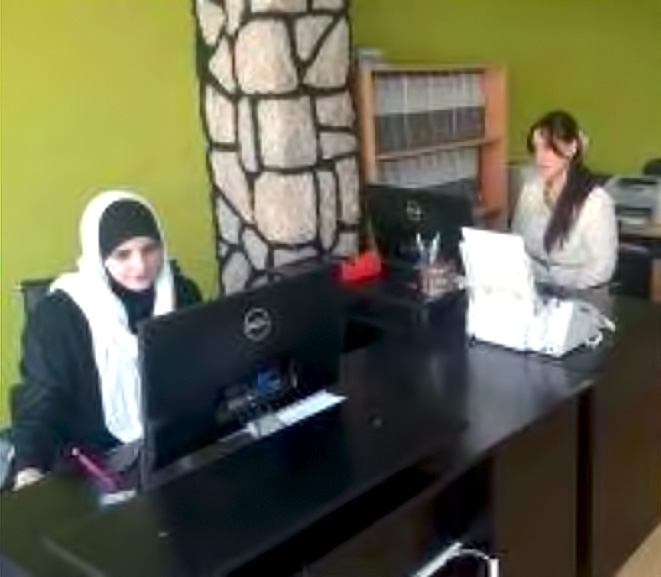
During the previous programme - EU PROGRES successfully supported 24 projects that have improved the position of women in local communities. Common obstacles to new businesses reported such as unfair competition, excessive taxes and debt collection were in most cases overcame by good planning learned in a preparatory phase of the activity. This in turn resulted in some thriving new women entrepreneurships.
Mejra Zahirović, young economist from Novi Pazar, had a clear vision, strong motivation, educational background and well –developed business plan when she applied for business start-up support. Today, she is running ‘Akademac Team’ a small company for provision of bookkeeping services and the production and distribution of promotional materials.
”The financial and technical support I received through EU PROGRES was indispensable. I am proud that the company now employs two more women. It is my personal goal to prove that successful entrepreneurship is also ‘women work’.” says Mejra.
European PROGRES will, as did its predecessor Programme, provide support with the overall business start-up issues including professional assistance in business management, legal issues, bookkeeping, mentoring support and other services depending on beneficiaries needs. This will ensure business sustainability and expectantly contribute to generation of at least 80 new jobs for women in 34 Programme municipalities by the end of 2017.
