


Passing by the neatly carved sign showing the previously unmarked road to villages of Golija mountain, you might not glance twice.
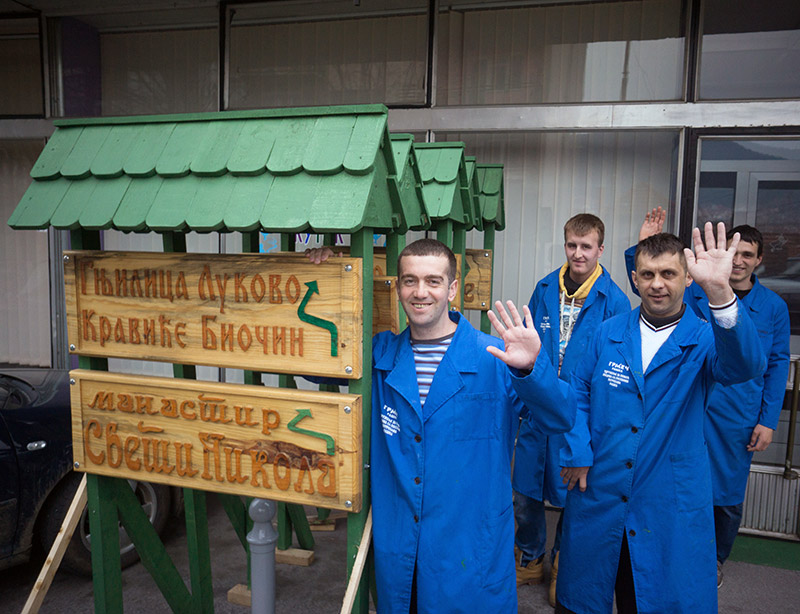
They fit seamlessly into their picturesque surroundings, pointing to the nearly forgotten villages on the road leading from Raška to Golija. Yet unlike the roads they mark, the story of how the signs came to be is extraordinary. It begins with one father’s firm decision to improve the quality of life of the disabled people in Raška.
“As a father of a child with disability I experienced first-hand how the lack of adequate social and financial support impacts the child as well as the whole family. My son Veljko is not physically able to work but that did not stop me to help enable his friends to work," says Zlatan Vukosavljević, the founder of the Association for Helping Persons with Special Needs in Raška.
In Serbia people with 70-80% disability receive social assistance equivalent to 80 Euros. This is meant to cover the living expenses and additional medical therapy.
The solution to address the needs of the disabled seems straight forward - create such conditions so that the people can achieve their full potential. However, the reality is complex. The needs are diverse and support is required in all stages of life - from early childhood, education, employment age to retirement. Sadly, in the country plagued by the chronic lack of funding and competing social priorities, the plight of people with disabilities has been side-lined for many years.
Social Welfare of Raška currently records 250 disabled residents, 90 of which are of employment age and living with caregivers. In Serbia people with 70-80% disability receive equivalent of 80 Euros in social support which should cover supplementary medical therapy and living expenses. Consequently even when possible, independent living is not an option due to lack of income. Institutional opportunities to obtain competitive education or vocational training for the disabled are limited and further exacerbated by the lack of access for those living in the remote and rural areas.
“When you live in a small town you get to know families that are dealing with similar issues so it was sensible to put the experience and the knowledge we acquired over the years to good use. This is how the Association was established,” says Zlatan. “Municipality of Raška recognised our initiative immediately and continues to support and help us in the effort to make our children’s life easier and enable them to take care of themselves when, one day, we are no longer around.”
Since its establishment in 2003 the Association provided various forms of support to its members but has since focused on the provision of the professional training and employment of people with disabilities which helps both the beneficiaries and their families.
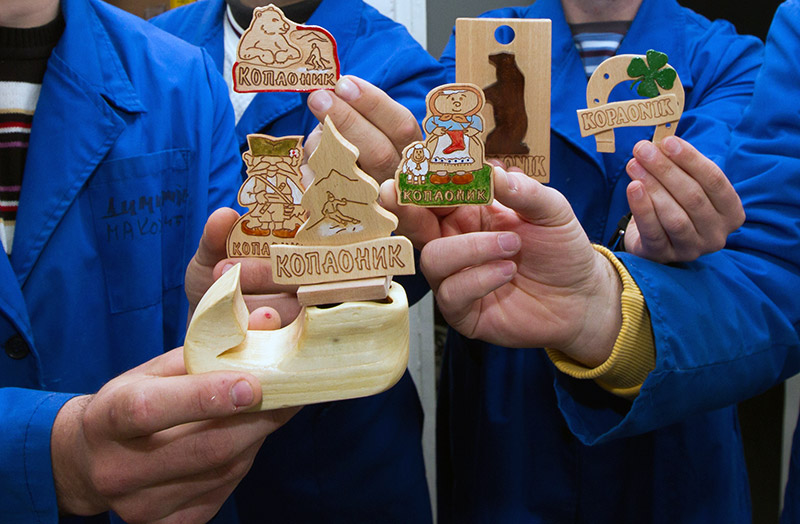
In 2011, with the financial support of the European Union and Government of Switzerland, through EU PROGRES’ Programme, the Association realized “Carpentry Workshop – A step to Independence” project which supplied the Association with the machines and tools and started the carpentry training for people with disabilities. Results were inspiring. In four years, some 45 beneficiaries were employed through public works in the production of, amongst other things, road signs for Golija villages. In 2015, through the EU PROGRES successor Programme - European PROGRES, the initiative expanded into training and employment of 10 persons with disabilities for the production of souvenirs. The project also envisages the purchase of specialised equipment and establishment of a permanent workshop for the production of keepsakes and other products made of wood that will be sold in Kopaonik and Golija tourist centres. The two activities should result in the secure income for the trained beneficiaries and it is expected that as the business grows workshop should both train and employ more, already interested, Association members.
We decided to create an environment that responds to the work needs of people with disabilities and the result is a workshop full of happy and productive workers.
“I know, from the personal experience, that people with disabilities are capable of achieving almost anything,” says Zlatan. “What they cannot do is conform to the standards of work and life that majority of people accept as a norm. This is why we decided to create the environment that conforms to their working needs and as a result we have a workshop full of happy and productive workers.”
This smiling faces of the employees who are willing to demonstrate how to produce an impressive keepsake of the Raška District, confirm this. Aco, Veljko, Milivoje, and Marko dominate the conversation about this life changing experience. They think of themselves as carpenters and feel confident about finding jobs in the future. The four of them are best friends.
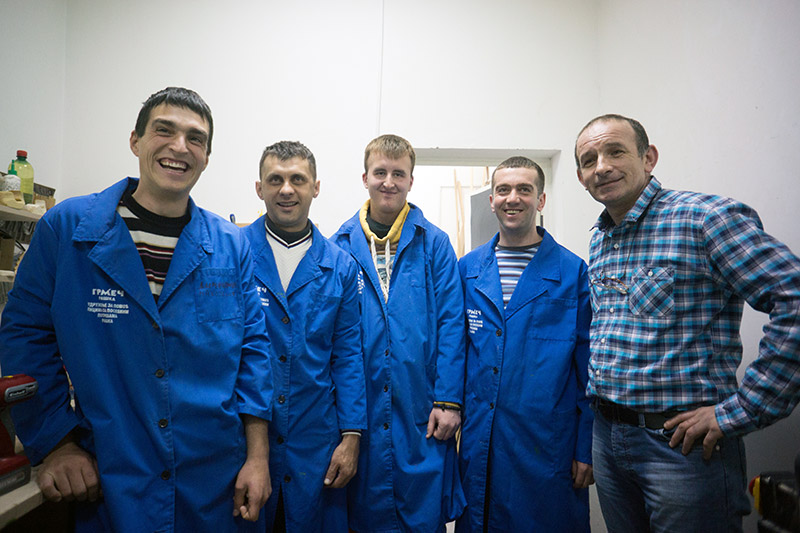
“Have you seen the Pavlica road sign? We made it! The weather was bad during the past month but we managed to put it up together!” said Milivoje.
Meanwhile in Raška, the production of souvenirs is searching for product placement and new customers that would enlarge the workshop workforce. Keep this in mind when looking for a reliable workshop to carve your keepsakes and wood products. And don’t forget to look for the signs along the road, they might be telling more than what you can see at the first glance.
"Together on the way to work” is one of 20 projects that received total of 382,000 Euros funding allocated by the European Union and the Government of Switzerland through European PROGRES’s Citizen Participation Fund (CIF). The implementing organisations and local self-governments are obligated to provide ten percent share per individual project. CIF projects focus on the area of social inclusion, migration and improvement of inter-ethnic dialogue. Current projects started with the implementation in February 2015 and will last between six and 12 months. Second round of Call for Proposals for new projects is expected mid-year 2016.
